
The energy explosion of AI, in numbers#
According to the International Energy Agency, global datacenters consumed approximately 415 TWh of electricity in 2024, roughly 1.5% of global electricity consumption. Over the last five years that figure grew at around 12% per year; the IEA projects the rate rising to ~15% per year from 2024 to 2030, more than four times faster than the rest of the global grid combined.
Under the IEA’s base case scenario, this consumption could reach 945 TWh by 2030:
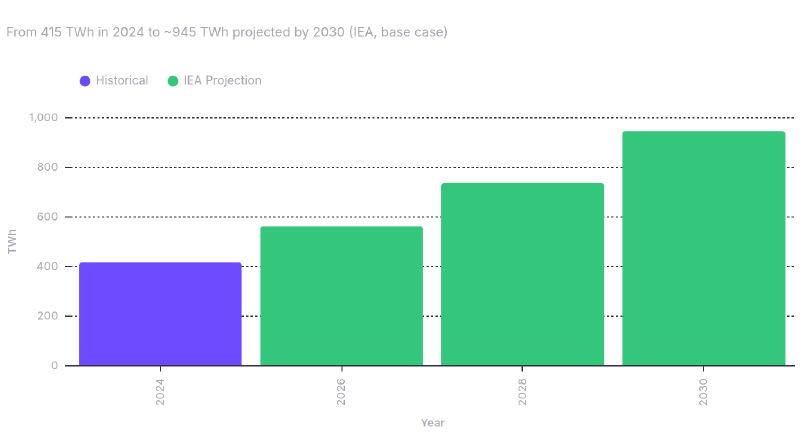
And this is only a base case. A separate analysis from the Öko-Institut, commissioned by Greenpeace Germany, warns that AI-specific datacenter demand could be up to 11 times higher than 2023 levels by 2030 in the absence of government intervention.
On the carbon side, a study cited by ScienceDirect (de Vries-Gao, 2025) estimates AI’s standalone footprint at 32.6 to 79.7 million tonnes of CO₂ in 2025, roughly equivalent to Belgium’s annual emissions.
Beyond carbon: the hidden cost of water#
Energy is only part of the equation. Cooling datacenters, particularly those running GPU clusters for AI training and inference, consumes enormous volumes of water.
MIT researchers estimate that datacenters consume roughly 2 liters of water per kWh for cooling. In regions already under water stress, that withdrawal puts direct pressure on local ecosystems and communities.
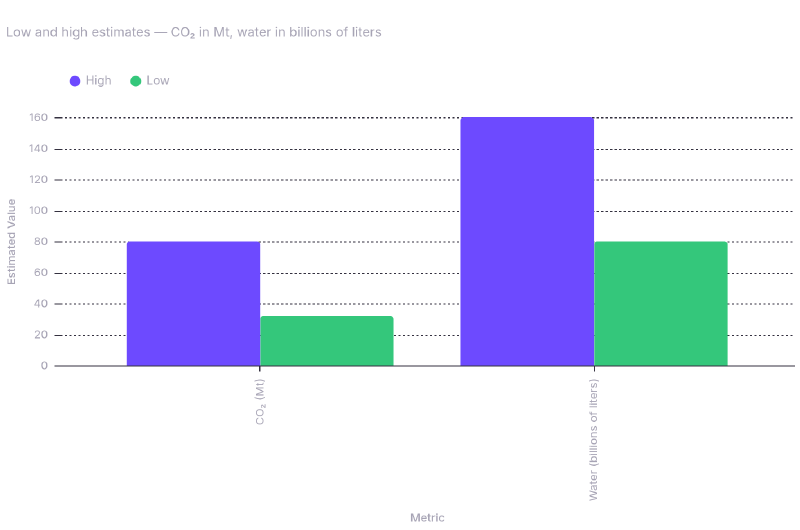
Water estimates are derived from total datacenter energy consumption, applying a 2 L/kWh ratio to illustrate the order of magnitude.
The rebound effect: when efficiency loses the race#
The core paradox isn’t new. It even has a name: the rebound effect (or Jevons Paradox). Every gain in energy efficiency gets canceled out, or exceeded, by the increase in overall demand.
In classic Green IT terms: optimizing your code reduces consumption per request, but if request volume triples, total footprint still goes up. With AI, this phenomenon reaches industrial scale.
As models become more capable, they get integrated everywhere: chatbots, image generation, real-time video analysis, autonomous agents. Every new application triggers millions of additional inferences. As the Cornell study (Nature Sustainability, Nov. 2025) puts it:
Even if each kilowatt-hour gets cleaner, total emissions can rise if AI demand grows faster than the grid decarbonizes."
The greenwashing of AI#
A report by Beyond Fossil Fuels published in February 2026 examined the tech industry’s claims about the climate benefits of AI. The result: 74% of assertions were unproven, and the report could not identify a single verified case where AI had demonstrably contributed to reducing overall emissions.
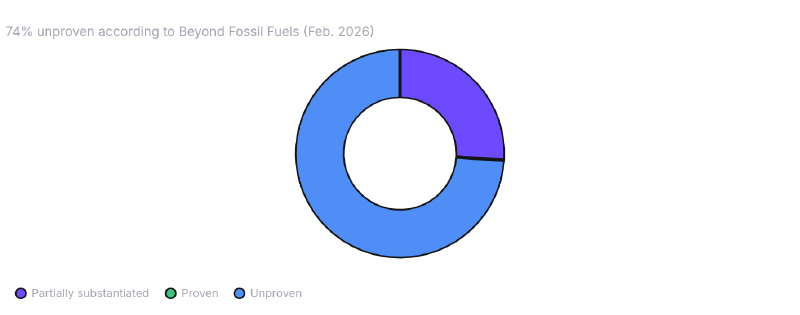
Between the promise of an AI that would optimize power grids and the reality of an infrastructure that keeps consuming ever more.
Solutions exist#
Academic research does offer concrete pathways. The Cornell study, focused on US AI infrastructure, outlines a roadmap showing that technical and strategic measures could cut the impact by:
- 73% for CO₂ emissions
- 86% for water consumption
…compared to the worst-case scenario for the United States.
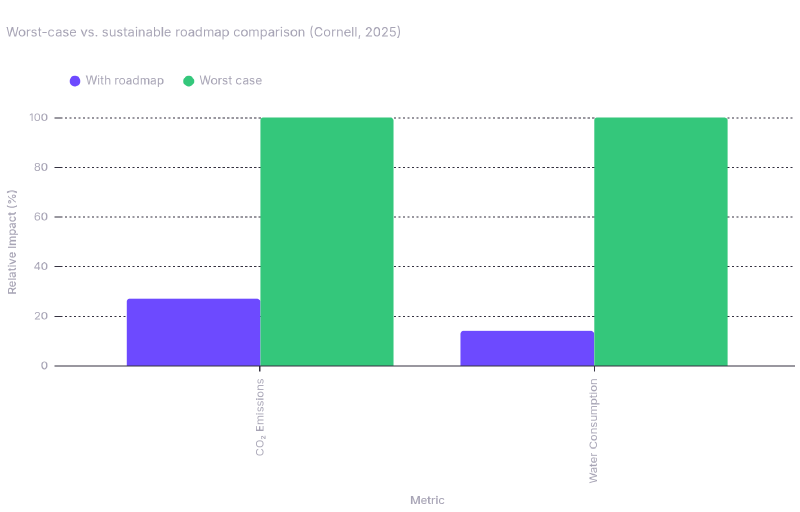
The levers span infrastructure, hardware, software, and policy.
Infrastructure: location and energy sourcing#
Where you build matters a great deal. The carbon intensity of electricity varies by a factor of 10 or more between the Pacific Northwest (hydropower-dominant) and the US Midwest (coal-heavy). Some operators now co-locate facilities next to wind or solar farms; others sign long-term Power Purchase Agreements (PPAs) that directly fund new renewable capacity rather than purchasing offsets after the fact.
24/7 carbon-free energy (CFE) goes further: matching consumption with clean generation hour by hour, not just on annual averages. Google and Microsoft have committed to it; most of the industry has not.
Hardware: efficiency at the silicon level#
Newer GPU and TPU architectures deliver more FLOPS per watt than their predecessors by a meaningful margin. Liquid cooling (direct-to-chip or immersion) removes the overhead of air-handling systems and enables tighter thermal management, recovering energy that would otherwise leave as heat.
Server utilization is chronically low across the industry, typically below 20%. Concentrating inference workloads on fewer, well-utilized machines rather than running fleets of half-idle servers cuts idle-power waste directly.
Model design: the software lever#
This is the lever most directly in practitioners’ hands. A fine-tuned 7B-parameter model frequently matches a 70B general-purpose model on constrained tasks, at a fraction of the inference cost. Quantization (INT8, INT4) or distillation can cut compute requirements by 2-4x with minimal accuracy loss.
Sparse architectures like Mixture-of-Experts (MoE), used in GPT-4, Mixtral, and DeepSeek, decouple model capacity from per-query cost by activating only a subset of parameters per inference pass.
Response caching and request batching help too: reusing results for repeated queries and grouping requests maximize GPU utilization per forward pass.
Measurement and accountability#
None of this works without numbers. Scope 1 (direct), Scope 2 (purchased electricity), and Scope 3 (supply chain and hardware manufacturing) emissions reporting remains rare and inconsistent across the industry.
The Green Software Foundation’s Software Carbon Intensity (SCI) specification and tools like CodeCarbon or Green Algorithms can measure the footprint of individual training runs and deployments. The EU AI Act and the proposed Corporate Sustainability Reporting Directive (CSRD) are beginning to mandate disclosure, which may move things faster than voluntary commitments have.
Counter-powers are organizing#
The debate has moved from conference rooms to courts and legislatures.
Regulation: Europe takes the lead#
The EU AI Act includes provisions on transparency and environmental impact. The CSRD extends mandatory climate disclosure to large companies operating in Europe, including their digital infrastructure. The Energy Efficiency Directive requires datacenter operators above a certain threshold to report PUE, water usage, and renewable energy share.
Local resistance: communities push back#
In September 2025, South Dublin County Council passed a motion calling for a national moratorium on new datacenters, or at minimum 100% renewable energy requirements.
The Netherlands imposed a construction moratorium on large datacenters near Amsterdam in 2023 following grid saturation concerns, and several municipalities have maintained restrictive zoning since.
In the UK, campaigners won legal standing to challenge a 90 MW hyperscale datacenter in Buckinghamshire after the government admitted a “serious error” in its environmental assessment.
Environmental groups in Germany and France are using impact assessment procedures to demand stricter scrutiny of large infrastructure projects.
Courts: the new frontline#
The UK case set a precedent worth watching: inadequate environmental assessment can be grounds to halt construction, which opens the door to similar challenges elsewhere in Europe.
Naming and shaming: targeting the narrative#
Beyond Fossil Fuels, Greenpeace, and Clean Creatives are taking a different angle, going after the advertising contracts that tech companies use to project a green image. If a company’s datacenter expansion contradicts its own climate commitments, the argument goes, the agencies producing the marketing share accountability.
Measurement frameworks: turning data into leverage#
The Green AI Institute, MIT, Berkeley Lab, and the UN University are publishing assessment frameworks, peer-reviewed research on datacenter energy and emissions, and the annual Digital Waste Monitor. These are increasingly cited in regulatory filings, litigation, and policy discussions, including the Cornell Nature Sustainability study referenced earlier.
What we, as developers, can do#
- Choose models suited to actual needs. A fine-tuned 7B-parameter model can match a 70B for many tasks, with a radically smaller footprint.
- Measure the impact of your AI deployments. Tools like CodeCarbon or Green Algorithms can estimate the carbon footprint of training or inference runs.
- Architect for efficiency: response caching, request batching, quantization, edge inference where appropriate.
- Ask your cloud and AI API providers about their energy mix and cooling practices. Transparency shouldn’t be optional.
- Document and share best practices within your teams and communities.
Conclusion#
Green IT hasn’t disappeared, but it is losing the battle for attention against a technological revolution whose energy footprint is unprecedented. The current trajectory is not sustainable, but the technical solutions exist.
We know how to make AI greener. The harder question is whether we will choose to do so before we are forced into it.
Writing more efficient code is part of it, but so is raising the uncomfortable questions during architecture reviews, vendor selections, and scaling decisions. Green IT is not a layer you bolt on at the end of a project. It belongs in the design conversation from the start.
References#
- Energy demand from AI (IEA)
- Environmental impact and net-zero pathways for sustainable artificial intelligence servers in the USA (Nature Sustainability)
- The carbon and water footprints of data centers and what this could mean for artificial intelligence (ScienceDirect)
- Explained: Generative AI’s environmental impact (MIT News)
- Roadmap shows the environmental impact of AI data center boom (Cornell News)
- The energy and environmental impact of AI and how it undermines democracy (Greenpeace International)